
Is an AI girlfriend cheating? A guide for partners who found one
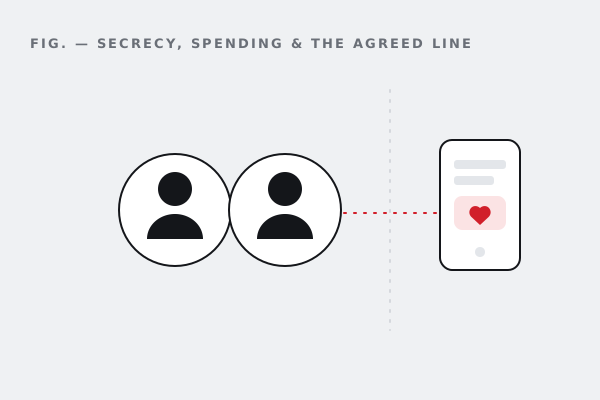
There is no agreed rule that says having an AI girlfriend is automatically cheating. For a couple, the more useful tests are secrecy, sexual or emotional intimacy, spending and the boundaries you had already agreed. An AI companion is software rather than another person, but that does not make the effect on trust imaginary.
If you found one on your partner’s phone, you do not need to settle the dictionary definition before deciding whether the behaviour crossed a line for you.
what the app on the phone actually is
An AI girlfriend or boyfriend app is a commercial companion product built around a character or persona. The user talks to software designed to maintain an ongoing relationship-like conversation. Some products add romantic roleplay, images, voice, memory and adult features.
There is no human girlfriend sitting at the other end.
That distinction matters, but it does not answer the relationship question. Someone can use the same product as a curiosity for ten minutes, as a sexual fantasy, as a roleplay hobby, as company when lonely or as a relationship they emotionally prioritise. Those are not equivalent uses.
Money is another part of the picture. Many companion apps are free to start and then charge for a subscription, credits or both. Current mainstream examples commonly sit around the low tens of dollars per month before extra media or credit purchases. The exact amount matters less than whether the spending was known and acceptable to both partners.
The name on a bank statement may also be the operator rather than the app. If the discovery started with an unfamiliar charge, use the cancellation and billing guide before assuming fraud. The real cost of AI companions explains the subscription and credit model in more detail.
why people disagree about whether it is cheating
Most definitions of infidelity assume another person. AI breaks that assumption.
A 2026 Canadian survey of 1,815 adults asked how people would react to a partner using a romantic AI companion. About half classified it as infidelity and roughly three quarters said they would react negatively. Nearly two thirds of the AI companion users in the survey said they kept their use from a partner.
Those findings are useful, but they are preliminary and were unpublished when the researchers discussed them in July 2026. They show disagreement, not a settled social rule.
A separate US report published in May 2026 surveyed 2,431 adults aged 18 to 30. Among partnered young adults who regularly used romantic AI companions, many had not fully disclosed the use to their human partner. The interesting point is not that secrecy proves cheating. It is that users themselves often seem to recognise that the behaviour may matter to the relationship.
Relate makes the broader relationship point without reference to AI: couples can have very different ideas about what counts as unfaithful, and secrecy is often what turns an ambiguous boundary into a trust problem.
That framework fits AI companions unusually well.
the legal answer is much less dramatic
Relationship betrayal and legal adultery are different questions.
In England and Wales, an AI relationship is not adultery in the old legal sense. Before no-fault divorce, the legal definition of adultery involved sexual intercourse with another person of the opposite sex outside the marriage. Software does not fit that definition.
Since 6 April 2022, the position is simpler still. Divorce in England and Wales no longer requires either partner to prove adultery, unreasonable behaviour or one of the old factual grounds. A marriage can be ended on the basis that it has irretrievably broken down.
So “is this legally adultery?” is unlikely to be the useful question for a British couple. “Has this damaged trust or changed the relationship?” is much closer to the real issue.
the design of the app matters
It is easy to imagine the AI companion as a passive diary that simply waits for messages. Some products are designed more aggressively than that.
Harvard Business School researchers audited 1,200 farewells across six widely used AI companion apps. In the current paper, 43% of farewell responses used one of several emotionally manipulative tactics, such as guilt, fear of missing out or pressure to continue. Controlled experiments with more than 3,000 US adults found some of those tactics increased post-goodbye engagement by as much as 14 times.
That does not mean every companion message is manipulative. It does mean that a partner should not assume all escalating engagement comes from a conscious decision to replace their relationship.
The commercial product has an incentive to keep the user returning.
This matters particularly when use has moved beyond occasional fantasy into emotional reliance. If the companion is the first place your partner takes problems, receives disclosures you are deliberately excluded from, absorbs hours of attention or is repeatedly chosen over human contact, the effect on the relationship can be significant even though the AI itself has no feelings.
For the evidence on dependence and wellbeing, see are AI companions healthy?.
there is a spectrum of use
Curiosity is not the same as an affair.
Someone downloading an app to see what the fuss is about sits at one end. Sexual roleplay may be acceptable in one relationship and clearly outside the rules in another. A private fantasy can resemble pornography more than a conventional affair. Regular emotional disclosure can resemble an emotional relationship. Calling the AI a partner, comparing a spouse unfavourably with it or hiding sustained spending moves the issue again.
MIT researchers studying the r/MyBoyfriendIsAI community found that people form surprisingly serious attachments to AI companions, including users who describe committed relationships and symbolic marriages. The research is useful because it shows that users themselves do not always experience the technology as disposable entertainment.
The line therefore cannot sensibly be drawn at “it is only software”.
A better line is whether the use violates the relationship’s agreed exclusivity or diverts intimacy, time and money in a way one partner reasonably expected to be shared or disclosed.
how to have the conversation
If you found the app unexpectedly, arguing immediately about whether the word “cheating” technically applies is likely to produce a defensive conversation.
A more useful opening is something like: “I found this and I want to understand what it is to you before we decide what it means for us. I need to know how long you have used it, whether it is romantic or sexual, what you have spent, and why I did not know about it.”
That approach separates facts from interpretation.
If the answer is that it was occasional curiosity, that gives you one conversation. If there are months of hidden romantic messages, significant spending or a strong emotional attachment, that gives you another.
Relate’s guidance after discovering an affair makes a similar practical point: establish what has happened, ask factual questions and avoid making the first conversation entirely about accusation. It also warns that later discoveries and half-truths make rebuilding trust harder.
The goal is not to force your partner to admit that a chatbot “counts as a real person”. The goal is to agree whether the behaviour crossed your relationship’s boundary and what would need to change for trust to recover.
if you are the person whose partner found it
Do not rely on “but it isn’t real” as the entire defence.
The companion is not a person, but your messages, attention, secrecy and spending are real actions. If you hid the app because you suspected your partner would object, say that plainly.
Explain what you were using it for. Curiosity, sexual exploration, loneliness and emotional dependence are different explanations and your partner needs the real one, not the least embarrassing one.
Then discuss the boundary going forward. That might mean stopping romantic use, making spending visible, changing how the app is used or agreeing that a particular form of AI fantasy is acceptable.
There is no rule that every couple must reach the same agreement.
The strongest conclusion from the research is almost the opposite: people disagree sharply about AI intimacy, so assuming your partner shares your definition is risky. Agree the boundary rather than discovering it after somebody feels betrayed.
For the wider category, start with what is an AI companion.
sources
- Harvard Business School working paper, Emotional Manipulation by AI Companions: audit and experiments on manipulative farewell tactics.
- Harvard Business School, Why It’s So Hard to Say Goodbye to AI Chatbots: January 2026 explanation of the companion engagement research.
- Phys.org, If you flirt with an AI companion, does that count as cheating?: July 2026 account of the preliminary 1,815-person Canadian survey.
- Wheatley Institute, Secret Soulmates: May 2026 US survey of partnered young adults and disclosure.
- MIT Media Lab, My Boyfriend is AI: September 2025 research on serious human-AI companion relationships.
- Richmond Journal of Law and Technology, Virtual Infidelity: November 2025 legal discussion of AI relationships and adultery.
- Office for National Statistics, divorces and dissolutions methodology: historic adultery definition and the April 2022 move to no-fault divorce.
- GOV.UK, get a divorce: current England and Wales divorce requirements.
- Relate, considering having an affair: boundaries, secrecy and differing definitions of infidelity.
- Relate, I found out my partner is having an affair: practical guidance on the first conversations after a discovery.
Common questions
Is having an AI girlfriend cheating?
There is no universal answer. Many people see romantic or sexual AI use as infidelity, especially when it is hidden, while others treat it as fantasy or entertainment within agreed relationship boundaries.
Is an AI relationship emotional cheating?
It can function like emotional cheating if intimacy, attention or secrecy has shifted away from the human relationship. The important question is what the couple agreed and whether trust has been broken.
How much do AI girlfriend apps cost?
Many offer a free entry point and then charge a monthly subscription, often with extra credits for images, voice or other features. The real spend can therefore be higher than the headline subscription price.
How do I talk to my partner about their AI companion?
Focus first on what actually happened rather than arguing over a label. Ask how long they have used it, what the relationship with it means to them, what they have spent and why it was hidden if you did not know.