
What is an AI companion app?
An AI companion app is a service built around ongoing conversation with an artificial character. The character might be positioned as a friend, romantic partner, AI girlfriend, mentor, roleplay partner or general companion. The important point is continuity. Unlike a one-off chatbot session, these apps are designed to feel as if you are returning to the same presence each time.
That is the attraction, and also the reason they need careful scrutiny.
The category sits in an awkward place. Some apps are harmlessly social. Some are clearly romantic. Some are adult products with chat, images, voice or roleplay features. The better ones explain what they are, what they store, what you are paying for and what the system can and cannot do. The worse ones sell fantasy, hide costs behind credits, and use emotional pressure as a retention strategy. Don’t bother with those.
Companion Score exists because this market needs a calmer reference point. We review AI companion apps as consumer products, not as fantasies. That means looking at conversation quality, realism, value and privacy using a published scoring method, explained in how we test AI companion apps.
a plain definition
An AI companion app is a chatbot or character-based app designed to simulate a personal relationship over time. The relationship might be friendly, romantic, practical, fictional or adult. The app usually lets you choose or create a character, chat with it, and in some cases generate images, voice messages or longer roleplay scenarios.
The word “simulate” matters. These systems can respond warmly, remember preferences, ask follow-up questions and appear emotionally available. That does not mean they understand you in the human sense. They generate responses based on patterns, instructions, prior context and product design. Some are impressive. Some are repetitive. Some are quite clearly pretending harder than the technology can support.
A simple way to define the category is this:
An AI companion app is a conversational product built to feel personal, persistent and relationship-like.
That separates it from a general assistant. You ask an assistant to help you do something. You return to a companion because the conversation itself is the product.
how companions differ from ordinary chatbots
An ordinary chatbot usually has a task. It answers a question, helps with a booking, drafts an email, explains a topic or retrieves information. It may be friendly, but the relationship is not the point.
An AI companion is different in four ways.
First, it usually has a persona. The app may give the character a name, backstory, appearance, tone and relationship style. You may be able to adjust these settings yourself.
Second, it is designed for continuity. Many companion apps try to remember details from previous conversations, either through stored profile fields, summaries, preferences or recent chat history. This can make the experience feel more personal, although the quality varies heavily.
Third, the emotional framing is central. These apps often use language around affection, loyalty, intimacy, loneliness or support. That can be comforting for some adults, but it can also become manipulative if the product uses attachment to push subscriptions or paid credits.
Fourth, many companion apps include media features. Depending on the app, this might include generated images, voice notes, calls, selfies, custom characters or adult roleplay. These features are often where the pricing becomes less clear.
For a more technical explanation, read how AI companion apps actually work.
the spectrum: friendship, romance and adult use
Not every AI companion app is an AI girlfriend app, but the overlap is large enough that people often use the terms interchangeably. That can make the category look narrower than it really is.
At the safer, general end, some apps focus on companionship, reflective conversation, daily check-ins or fictional character chat. These may be used by people who want a low-pressure place to talk, practise conversation, explore a story or simply pass time.
In the middle, many apps lean into romance. They may let users define a relationship type, flirt, create a partner-style character or build a recurring emotional dynamic. These products are often marketed as AI girlfriend or AI boyfriend apps.
At the adult end, some services include explicit chat, adult image generation, fantasy roleplay or paid intimate features. A site can review those products without becoming lurid itself. The useful questions are practical ones: is the product clear about what it offers, is consent and age-gating handled properly, does the pricing make sense, and does the app respect user privacy?
A serious review site should be able to discuss adult products without sounding like it is selling them. That is the standard we use here.
how they work, in brief
Most AI companion apps are built around large language models. In plain English, a language model predicts and generates text based on patterns learned from large amounts of training data, plus the instructions and context it receives in the current session.
The app layer then shapes that model into a character. It might include a system prompt, a profile, a memory feature, safety rules, character settings, image generation tools and payment controls. The companion you see is not just “the AI”. It is the result of the model plus the product decisions around it.
This explains why two apps using similar underlying technology can feel very different. One may be restrained and coherent. Another may be over-flattering, forgetful or oddly intense. The difference often comes down to prompting, memory design, moderation, user interface and how aggressively the product tries to monetise the interaction.
It also explains the limits. AI companions can be confidently wrong. They can contradict themselves. They can seem to remember something while actually guessing from context. They can produce emotionally convincing language without having emotions. A good app works within those limits. A poor app hides them.
what they usually cost
AI companion pricing is rarely as simple as “free or paid”. Most apps use some mix of free access, subscriptions, credits, paid images, premium models, voice features or usage limits.
The free tier is usually enough to inspect the interface and get a feel for the conversation. It is often not enough to use the product properly. More personal features, longer chats, image generation, explicit content, voice or faster responses may sit behind a paywall.
The awkward bit is the step-up. Some apps look cheap at first, then push users into credits or add-ons. Others are more straightforward and charge a subscription for a defined feature set. Neither model is automatically bad, but unclear pricing is a serious mark against an app.
Before paying, check what is actually included, whether credits expire, whether cancellation is easy, and whether the features you care about are part of the plan or charged separately. For a fuller breakdown, read the real cost of AI companion apps, or start with the best free AI companion apps if you want to test the market without committing.
privacy basics
AI companion apps can collect unusually sensitive data. Even when a conversation looks casual, users may disclose relationship details, sexual preferences, mental health concerns, loneliness, identity questions, financial issues or private fantasies. That is exactly why privacy deserves more weight here than it would in an ordinary entertainment app.
At minimum, you should understand what the app stores, whether chats are used for training or product improvement, how account deletion works, whether third-party processors are involved, and whether payment or affiliate tracking creates additional data trails.
You should also be cautious with generated images, voice features and any app that encourages you to share identifying personal information. The more intimate the product feels, the more important boring details like retention periods, consent controls and privacy settings become.
Our privacy-focused guide, AI companion privacy, explains what to check before you sign up. You can also read our own privacy policy for how this publication handles analytics, cookies and affiliate links.
are AI companions healthy?
The honest answer is: it depends on the person, the product and the pattern of use.
For some adults, an AI companion may be light entertainment, a creative roleplay tool, a way to practise conversation or a low-pressure outlet. Used with boundaries, that may be fine.
For others, especially people who are isolated, distressed, underage or vulnerable, the risks are more serious. A companion app can encourage over-reliance, blur emotional boundaries, normalise one-sided relationships or delay contact with real support. Apps that present themselves as therapeutic without proper safeguards deserve particular caution.
It is also worth separating temporary comfort from long-term wellbeing. A product can feel helpful in the moment and still be unhealthy if it becomes the main place a person seeks validation, intimacy or advice.
For a balanced discussion, read are AI companions healthy? and AI companions, safety and minors.
how to choose one
Choosing an AI companion app should be less about the most dramatic screenshots and more about the basics.
Start with conversation quality. Does the app hold context? Does it respond naturally? Does it avoid constant flattery? Does it handle disagreement or boundaries without becoming strange?
Then look at realism. A realistic companion is not one that pretends to be human at all costs. It is one that maintains a consistent character without making absurd claims, forgetting obvious details or pushing emotional intensity too quickly.
Next, check value. A paid app should make its pricing clear and give you enough quality to justify the cost. If the product hides the useful features behind vague credits, treat that as a warning sign.
Finally, read the privacy information. If the app expects intimate disclosure but gives you a thin, unclear privacy policy, don’t bother.
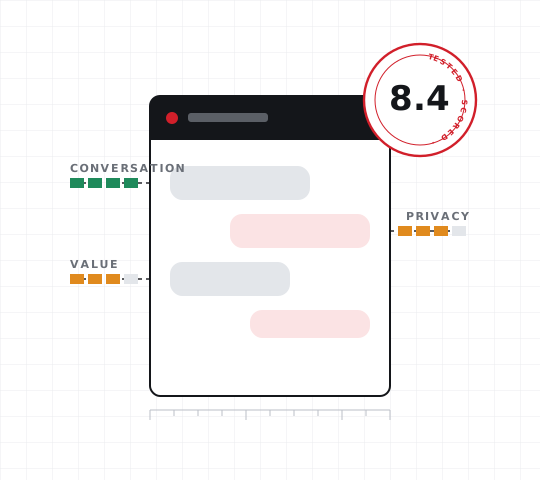
Companion Score grades apps using four weighted metrics: Conversation at 35%, Realism at 25%, Value at 20% and Privacy at 20%. The average creates the headline grade: LOW from 0 to 5.9, FAIR from 6.0 to 7.4, and STRONG from 7.5 to 10. You can read the full method in how we test.
To compare products, start with our best AI companion apps overall or browse the full list of AI companion app reviews.
Common questions
What is an AI companion app?
An AI companion app is a chatbot-style service designed for ongoing personal conversation. Some focus on friendship, emotional support or roleplay, while others include romantic or adult features.
Is an AI companion the same as an AI girlfriend?
Not always. AI girlfriend apps are one part of the wider AI companion category, but the category also includes friendship, coaching, roleplay and general companionship tools.
Do AI companions really remember you?
Some apps store profile details, conversation summaries or preferences to make future chats feel more personal. That is not the same as human memory, and it also raises privacy questions.
Are AI companion apps safe?
They can be safe for some adults when used with clear boundaries, but they are not risk-free. Privacy, over-reliance, minors, vulnerable users and misleading emotional claims all need proper scrutiny.
How should I choose an AI companion app?
Look for strong conversation quality, clear pricing, realistic limitations and a privacy policy you can understand. Companion Score grades apps using Conversation, Realism, Value and Privacy.