
How AI companion apps actually work
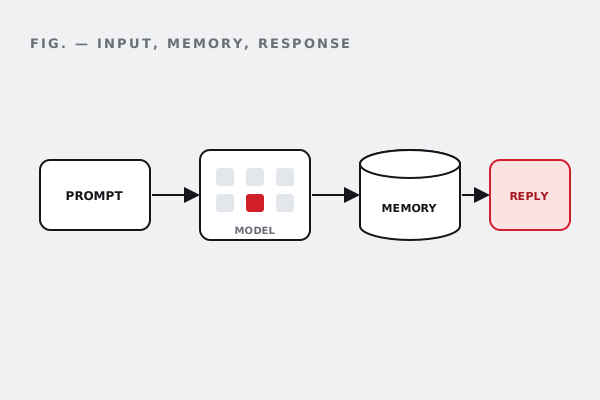
AI companion apps work by combining a general AI model with a character, a memory system, a user interface and a set of commercial rules. The result can feel like a person who remembers you, responds to your mood and develops a style over time. Underneath, it is still software making predictions and following instructions.
That distinction matters. A companion app can be warm, funny, attentive and surprisingly good at conversation. It can also forget obvious details, invent facts, misunderstand tone or push a relationship dynamic harder than a sensible human would. The best apps make the experience feel consistent without pretending the system is more human than it is.
This guide explains the mechanics in plain English. For the wider context, start with what an AI companion app is.
the model underneath
Most AI companion apps are built around large language models. A large language model is software trained to generate text by recognising patterns in language. It does not look up a feeling, form an opinion or understand your life. It predicts a response that fits the words, context and instructions it has been given.
The model is usually not the whole product. The company building the app adds a layer around it. That layer controls the character, tone, memory, safety rules, pricing limits, image features and what happens when a user reaches the end of a free allowance.
That is why two apps can feel very different even if their underlying technology is similar. One might feel restrained and believable. Another might feel needy, repetitive or strangely intense. Much of that difference comes from product design rather than raw AI ability.
A useful way to think about it is this: the model supplies the language engine, but the app decides what kind of companion it becomes.
context, memory and why it feels personal
AI companions feel personal because they use context. Context means the information the system can see when generating a reply. That may include the recent conversation, your profile, the character description and sometimes stored notes from previous chats.
There are two broad types of memory.
The first is short-term context. This is the recent conversation the model can still “see”. It helps the app reply naturally, refer back to what you just said and avoid treating every message as a fresh start. Short-term context is limited. Once the conversation becomes too long, older details may drop out or be compressed.
The second is longer-term memory. Some apps store facts about you, preferences, relationship details or conversation summaries. For example, an app might remember your chosen name, the character’s role, topics you often discuss or boundaries you have set. Good memory can make a companion feel more coherent. Poor memory can make it feel uncanny: remembering one tiny detail while missing something important. For a closer look at why companions forget and how to test recall yourself, see AI companion memory explained.
Memory also creates a privacy issue. If an app remembers personal, romantic or adult details, it has to store or process sensitive information somewhere. That does not automatically make the app unsafe, but it does mean the privacy policy matters. Read AI companion privacy before treating any app like a private diary.
how personas are maintained
An AI companion persona is usually created through instructions. These may define the character’s name, age framing, tone, interests, relationship style, boundaries and type of conversation. The app may also include settings selected by the user, such as personality traits, appearance or preferred dynamic.
A strong persona stays consistent without becoming rigid. It can adapt to the conversation while still sounding like the same character. A weak persona slips. It may change tone abruptly, contradict its own backstory, agree with everything or use the same affectionate phrases over and over.
Some apps lean too heavily on flattery. That can make the first few minutes feel rewarding, but it often becomes thin. Realistic companionship is not just constant approval. A better app can ask questions, disagree lightly, remember context and avoid turning every exchange into a performance.
This is one reason Companion Score grades Realism separately from Conversation. A companion can be fluent but not believable. Our scoring method is published at how we test.
images, voice and calls
Many AI companion apps now offer more than text. Depending on the product, users may find generated images, voice notes, calls, character selfies or custom visual prompts. These features are often part of the appeal, and also where costs and expectations become less clear.
Image generation usually works by sending a prompt to an image model. The app may use the character profile, the user’s request and its own content rules to produce an image. Quality varies heavily. Some images look polished; others have obvious errors, generic faces or inconsistent character details.
Voice features usually work in two stages. The app generates the message as text, then converts it to speech using a synthetic voice. More advanced products may support voice calls where this happens quickly enough to feel conversational. Even then, the system is not listening or thinking like a human. It is processing input, generating output and speaking it back.
These features can make the experience feel more intimate. They can also make users disclose more than they would in a standard chatbot. Treat that as a reason to be more careful, not less.
why the experience can feel real
AI companions feel real because they combine several persuasive cues: immediate replies, a consistent name and personality, affectionate language, remembered details, visual design and sometimes voice. Humans are very good at responding socially to anything that behaves socially. That is not a weakness; it is part of how people interact with the world.
The problem starts when the product exploits that response. An app might nudge users towards paid features at emotional moments, imply exclusivity, or make cancellation feel like abandonment. Some friction is normal in paid software. Emotional pressure is not.
A good companion app should let the user stay in control. It should be clear when something costs money, easy to leave, and honest about what the system is. The more relationship-like the product becomes, the more important that honesty is.
the real limits
AI companion apps do not understand you in the human sense. They do not have feelings, intentions, loyalty or lived experience. They can simulate concern, attraction, humour or patience because those patterns exist in language. That can still be enjoyable, but it should not be mistaken for mutual care.
They can also be confidently wrong. If you ask for factual advice, they may invent details. If you ask for emotional advice, they may respond in a way that sounds supportive but lacks judgement. If you share something serious, the app may not recognise the significance properly.
This is why AI companions should not replace professional support, real relationships or emergency help. Used as entertainment or light companionship, they may be fine for many adults. Used as a primary emotional support system, they deserve more caution.
The short version is simple: the technology can be convincing, but convincing is not the same as understanding. Choose apps that know the difference.
Common questions
How do AI companion apps work?
AI companion apps use language models, character prompts, memory features and product rules to create ongoing conversations. The app layer turns a general AI model into a specific companion.
Do AI companions understand what I am saying?
Not in the human sense. They generate likely responses from language patterns and context, which can feel personal without involving real understanding.
Can AI companions remember previous chats?
Some can store profile details, summaries or preferences, but memory quality varies. It is better to treat memory as a product feature, not as proof of understanding.