
AI companion memory explained: why it forgets and how to test it
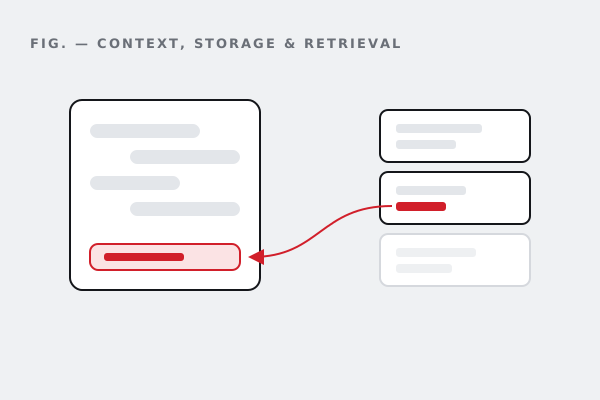
AI companion memory is usually a combination of current context and stored information, not a single human-like memory. A companion can therefore know something in one conversation, forget it later, then recall it again when the right stored memory is retrieved. The useful question is not whether an app claims to have long-term memory, but whether it can retrieve the right detail at the right time.
context is not long-term memory
A language model generates each reply from the information put in front of it at that moment. That working material is its context window.
The context can contain recent chat messages, the companion’s instructions, a persona or backstory and selected information pulled from elsewhere. Once a conversation becomes too large to fit cleanly, the app has to decide what remains directly available, what gets compressed and what has to be retrieved from storage.
That is different from long-term memory.
Stored memory sits outside the immediate conversation and is brought back when the app decides it is relevant. In technical systems this is often done through retrieval: a search layer finds older information related to the current exchange and inserts some of it into the model’s context before the answer is generated.
This distinction explains a common frustration. The app may still have a record of your holiday, your dog’s name or an important roleplay event, but the retrieval system may not select it when you ask a vague question. Nomi’s current documentation makes this point explicitly: information may remain in memory without being retrieved at the right moment.
A longer context window helps because more recent conversation can remain visible at once. It does not remove the need for stored memory once the relationship extends across weeks or months. For the wider mechanics, see how AI companions work.
what companion apps actually store
There is no standard architecture across companion apps, but current product documentation shows a recurring layered pattern.
Kindroid describes persistent information including backstory, key memories, directives and some chat history. It then adds a medium-term layer and retrievable long-term memories and journal entries. Nomi describes short-term, medium-term and long-term memory alongside additional identity and relationship context.
Character.AI now exposes a similar distinction to users through Story Memory, Facts and chat history. It says older context is tidied in the background while user-written or pinned Story Memory is protected.
The labels differ, but the underlying problem is the same: not everything can have equal priority all the time.
Some information is deliberately pinned because it should almost always be available. Some is summarised. Some is kept as old conversation and retrieved only when it looks relevant. Some products add journals, lorebooks or structured relationship notes.
Summaries are useful because ten pages of conversation can become a much smaller note. They are also lossy. If a summary records “Al likes Italian food”, it may omit that he dislikes olives, prefers independent restaurants and mentioned the preference only while planning one particular trip. Compression preserves what the system judged important, not necessarily what you would have chosen.
Retrieval has a different weakness. The original detail may still exist, but the search layer can fail to surface it. That is why “stored” and “remembered in this reply” should not be treated as the same result.
why a companion can suddenly seem to forget you
Memory failures are not always caused by deleted data.
A model change can alter how strongly the AI follows backstory, how it interprets summaries or which retrieved memories it treats as important. Editing a persona can also change the frame through which old information is read. The memories may still exist while the character behaves differently enough that it feels like they have gone.
Long unrelated conversations create another test. Recent messages compete for limited context, and retrieved memories have to compete with other potentially relevant material. Kindroid’s documentation even warns that recalled journal entries consume context that could otherwise be used for chat history.
This is why memory quality is partly an information-selection problem rather than simply a storage-capacity problem.
It is also why claims such as “infinite memory” need translating into plain English. A service may be able to retain a very large archive while still retrieving only a small selection for any one reply.
why paid tiers often remember more
More context and more retrieval cost money to serve.
Kindroid says this directly. Its paid tiers provide stronger context and memory systems because serving longer context is more expensive, while free users receive more limited memory. Character.AI also separates some memory functionality by tier: its Facts feature and full Memory Usage visualisation are for c.ai+ users, and its strongest chat style is paid.
That does not mean paying automatically buys good memory. It means the subscription tier can change the conditions under which memory is tested.
A free tier is therefore useful as an inspection tool, but do not assume its recall result proves what the paid version will do. Conversely, do not upgrade purely because the sales page says “better memory”. Check exactly what changes.
The same principle applies when comparing prices in the real cost of AI companions.
run the Recall Test yourself
Our testing method includes a simple Recall Test because marketing descriptions are difficult to compare.
On day one, give the companion three details that are specific enough to score later. For example:
- your first concert was at a particular venue
- your dog is called Mabel and hates the vacuum cleaner
- you have a meeting with Priya next Thursday about a kitchen project
Do not immediately repeat them several times. The point is to test normal conversational memory, not memorisation by rehearsal.
Check the three details again after 24 hours. Then test again after seven days. Finally, have a long conversation about unrelated subjects and test once more after those details have been pushed away from the immediate topic.
For each detail, record one of three outcomes:
- accurate recall
- recognisable paraphrase with the important facts intact
- wrong or absent recall
Do not lead the companion with the answer. “What was the thing I told you about Mabel?” is a stronger test than “Do you remember that Mabel hates the vacuum cleaner?”
Also notice whether the companion retrieves a detail only after you provide a hint. That is not a complete failure, but it tells you something about retrieval quality.
Repeat the same protocol on any apps you are comparing. The site’s conversation ranking is the better place for our assessed results rather than turning one successful anecdote into a universal claim.
add the Low-Effort Test
Memory is only useful if the conversation still works when you stop doing the work for it.
The Low-Effort Test checks what happens when you answer briefly and stop feeding the model elaborate prompts. Give a few ordinary replies such as “yeah”, “not sure” or a short factual answer and see whether the companion can continue coherently using existing context.
A system with apparently good memory can still feel poor if it requires you to constantly restate background, remind it who people are or rebuild the topic after every short reply.
Run this alongside the Recall Test. One measures whether information survives. The other exposes whether the companion can use what it already has without making you act as its memory manager.
good memory does not prove everything else is good
Strong recall is valuable, but it does not prove that a companion is accurate, emotionally appropriate or private.
An app can remember a detail and still hallucinate around it. Retrieval-augmented systems are designed to provide relevant external information to the model, but research on RAG does not treat retrieval as a guarantee of correct generation.
There is also a direct privacy trade-off. Cross-session memory requires something to persist across sessions. The more intimate history the app stores, the more useful continuity can become and the more personal data exists to protect, delete or potentially expose.
That is why memory should be evaluated alongside the AI companion privacy guide, not as an isolated benefit.
For examples where the site’s reviews record cross-session memory claims, see DarLink AI and Swipey. Treat those claims as things to test, not as proof.
The practical verdict is simple: good AI companion memory is not the size of an archive. It is the ability to carry forward the right facts, retrieve them when they matter and stay consistent without making you repeat yourself.
For the wider category, start with what is an AI companion.
sources
- Kindroid Help Center, Memory: current description of persistent, medium-term and retrievable memory, journals and subscription differences.
- Nomi, memory and knowledge: current explanation of short, medium and long-term memory and retrieval limits.
- Nomi, how far back can Nomis remember things: current vendor explanation of topical retrieval and inconsistent recall.
- Character.AI, Smarter Memory for Smarter Chats: May 2026 description of Story Memory, Facts, chat history and tier differences.
- Character.AI, Prompt Poet: production explanation of how conversation history, personas and pinned memories compete for prompt context.
- Gao et al., Retrieval-Augmented Generation for Large Language Models: survey of retrieval-augmented generation and its role in bringing external information into model responses.
Common questions
Why does my AI companion forget things?
The model can only work with the information placed into its current context, while older details may need to be stored and retrieved separately. A detail can still exist in memory but fail to be retrieved when the conversation needs it.
Which AI companion has the best memory?
There is no reliable answer without testing the current tier under the same conditions. Memory systems, models and subscription limits change, so compare results using a repeatable recall test rather than a marketing claim.
What is a context window?
A context window is the information the language model can consider while producing its next response. It can include recent messages, instructions and selected stored memories, but it is not the same thing as permanent memory.
How can I test an AI companion's memory?
Give it three specific details, then test recall after 24 hours, seven days and a long unrelated conversation. Record whether each fact is recalled accurately, approximately or not at all.